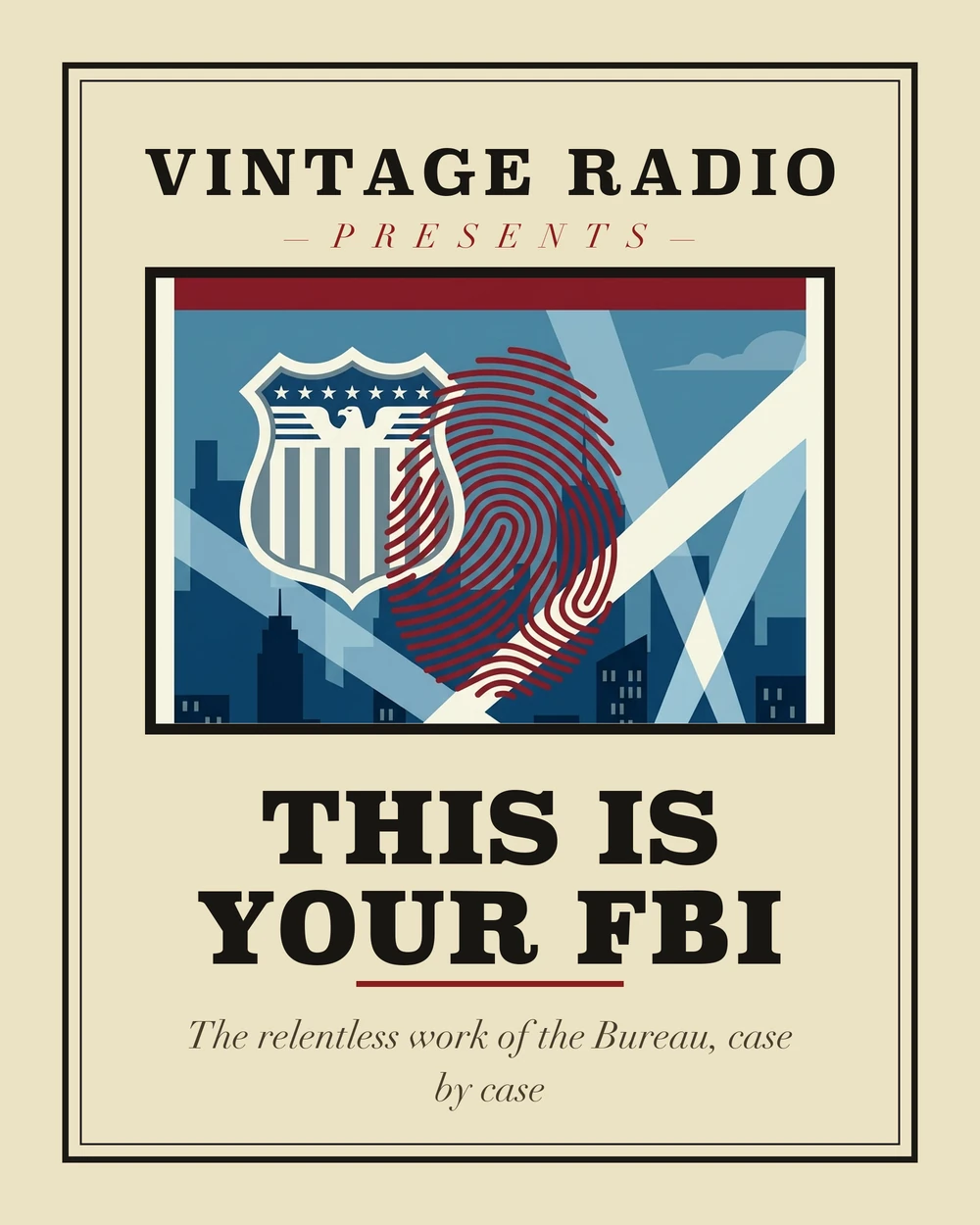
This Is Your FBI
The Show J. Edgar Hoover Called His Own
Few radio programs could claim the kind of institutional backing that This Is Your FBI enjoyed from the moment it premiered on April 6, 1945. J. Edgar Hoover appeared on that very first broadcast, and he considered the show — in his own words — "the finest dramatic program on the air." The Bureau itself referred to it as "our show," a characterization Lynn Vines used in a 1981 historical overview published in the FBI newsletter. That relationship shaped everything about the program: its access, its authenticity, and its particular way of framing the FBI as an institution beyond reproach.
Producer-director Jerry Devine had earned that access the hard way. Before the show aired, he spent two weeks at the FBI school in Quantico, Virginia, going through orientation as a recruit would. He was then given the run of closed case files, with permission to dramatize them as long as names and places were changed. He made semi-annual trips to Washington throughout the run to stay current — studying new lab techniques, sitting down with Hoover and assistant FBI director Louis Nichols to discuss upcoming programs. The result was a Crime-Detective series that could credibly claim something its chief competitor on radio could not: an actual pipeline into Bureau files.
Devine came to the assignment by an unlikely route. He had started as a comedy writer for Kate Smith and Tommy Riggs before turning to thrillers, and by 1941 he was writing for Mr. District Attorney. The shift from comedy to crime drama suited him, and his earlier credits included The Shadow on Mutual and Reg'lar Fellers.
Two Cities, Two Formats
This Is Your FBI had two distinct lives, divided roughly by geography. From 1945 to 1947, the show was produced in New York, and the format was pure anthology — a different field office, different agents, different case each week. The cast rotated through recognizable radio talents: Mandel Kramer, Karl Swenson, Santos Ortega, Elspeth Eric, Joan Banks, and Helen Lewis. Frank Lovejoy handled narration in 1945; Dean Carlton took over from 1946 into 1947. Carl Frank and Milton Cross served as announcers, and the orchestra was led by Nathan Van Cleave and, increasingly, Frederick Steiner. William Sweets shared directing duties with Devine, while Frank Phares and Lawrence MacArthur wrote the scripts.
A newspaper announcement promoting the show's debut promised that This Is Your FBI would "show graphically exactly how enemies of the United States have, and are, operating, and how FBI agents and American citizens are cooperating to circumvent their activities," and described crime as "a dirty stab at every citizen and his country." The first-year stories reflected that pitch: Nazi agents, escaped German prisoners of war, traitors, saboteurs. These were cases drawn from a Bureau that had spent the war years hunting domestic enemies, and the show treated them accordingly — the FBI as the nation's last internal defense.
When production moved to Hollywood around 1948, the format shifted. The rotating-agent anthology gave way to a central character: Jim Taylor, a fictitious Special Agent working cases on the West Coast. Stacy Harris played Taylor for the rest of the run, and the cast around him included William Conrad, Bea Benaderet, Georgia Ellis, Carleton Young, Jay C. Flippen, Herb Ellis, Michael Ann Barrett, Whitfield Connor, and Betty White. William Woodson took over narration, Larry Keating became announcer, and Jerry D. Lewis replaced the New York writing team. Frederick Steiner continued leading the orchestra. Devine remained at the helm throughout.
Taylor's Hollywood-era caseload moved with the times — military frauds, juvenile delinquency, hijackers, bank robbers, embezzlers. The storytelling approach also changed: the Hollywood episodes used a split viewpoint, alternating between the perspective of the agents and that of the criminals, which gave the drama a bit more texture than a straight procedural.
Stacy Harris and the Voice of Jim Taylor
Jim Taylor had actually appeared briefly in the New York period — Harris first played the character in February 1946 — but the role didn't become the show's center of gravity until the Hollywood move. Devine explained his casting choice to newspaper columnist Jack O'Brian in 1946: "Stacy has just the sort of voice I need for the quiet authority of the special agent on my show. On top of that, he's a good actor, and it's a combination on radio which can't be beat."
Harris brought an unusual background to the role. Born Stanley Harris on July 26, 1918, in Big Timber, Quebec, he was the son of Shakespearean actor David Stanley Harris and attended the University of Washington. Before any of his acting work he had been a sketch artist for the Seattle Post-Intelligencer, an announcer and newscaster at KRSC in Seattle, and a police reporter for the San Francisco Chronicle. He had appeared in five Broadway plays and received a New York Critics Award. He served in World War II as a merchant seaman and with the British Eighth Army as a motorcycle courier and reconnaissance car driver, receiving the Croix de Guerre for service in North African campaigns including El Alamein.
His radio résumé extended well beyond Jim Taylor — Batman on The Adventures of Superman, Ted Blades on The Strange Romance of Evelyn Winters, and roles on Confession, Dragnet, Pepper Young's Family, and Frontier Gentleman. His friendship with Jack Webb ran deep enough that Webb named one of his daughters Stacy in the actor's honor. Harris made his film debut in the Alan Ladd and Jack Webb picture Appointment with Danger in 1950, and after radio he went on to more than 100 television roles, appearing five times in the original 1951–54 Dragnet run and eight more times in the 1967–70 revival, along with Adam-12, Emergency!, and other Jack Webb productions. He died in Los Angeles on March 13, 1973, at fifty-four.
The Music Behind the Cases
The score for This Is Your FBI has a history worth tracing. Nathan Van Cleave led an 18-man orchestra for the New York production, but Frederick Steiner had actually been composing for the show without credit since its inception. Van Cleave turned the show over to Steiner full time just before leaving for Hollywood, with Leith Stevens serving briefly as music director in between. Steiner composed and arranged music for 47 episodes of the radio series before eventually following the production west in 1947.
Steiner's background was serious: his father was George Steiner, a Hungarian-born composer and violinist who had studied with Zoltán Kodály. Frederick Steiner had begun playing piano at six and received his degree in music composition from the Oberlin Conservatory of Music in 1943. His later career would take him well beyond radio — he composed the Perry Mason television theme ("Park Avenue Beat"), wrote music for The Rocky and Bullwinkle Show, contributed scores or conducting to 29 episodes of Star Trek: The Original Series, and received a shared Academy Award nomination for The Color Purple in 1985.
The Rivalry with The FBI in Peace and War
Radio critics and listeners inevitably stacked This Is Your FBI against its obvious competition, The FBI in Peace and War. Radio Life concluded that both shows were worthy and that there was little to distinguish one from the other — a judgment that stung a bit given how much Devine had invested in official access. The comparison had some basis: both shows framed the Bureau as the relentless enemy of crime, both used bouncy march music, and both featured agents of what was charitably described as a "faceless nature." The fictional Field Agent Shepherd from Peace and War and Special Agent Jim Taylor were, by one account, interchangeable enough that swapping them would have drawn few complaints. The original This Is Your FBI theme conveyed the same relentless fight against crime that Prokofiev's The Love for Three Oranges did for the rival show.
The key difference was on paper rather than on air. This Is Your FBI had genuine access to Bureau files; The FBI in Peace and War was largely fiction, even though its source author Frederick L. Collins had received Bureau cooperation in his research for the original book. The radio version of Peace and War remained unsanctioned by the FBI, which made Hoover's embrace of Devine's show all the more pointed. Both programs glorified the Bureau and assured listeners that criminals were inevitably tracked down — but only one of them could say it was doing so with Hoover's blessing in the room.
The New York Times critic Jay Gould acknowledged that "characterizations are credible and often embellished with subtle twists that heighten the dramatic effect," though he also noted the show's "rather effusive praise for Mr. Hoover and the FBI" was a bit overdone.
Eight Years, One Sponsor, One Point of View
This Is Your FBI ran every Friday at 8:30 for eight years on ABC, from April 6, 1945, to January 30, 1953. The Equitable Life Assurance Society of the United States sponsored every single episode — all 409 of them. Announcer Larry Keating delivered the line that tied the whole enterprise together at the end of each broadcast: "To your FBI you look for national security, and to your Equitable Society for financial security. These two great institutions are dedicated to the protection of you, your home, and your country!" The parallel was deliberate and the branding seamless.
The show was not afraid to wade into the politics of its moment. In 1951, as the tactics of the House Committee on Un-American Activities were drawing increasing public scrutiny, the program aired a story about a man cleared by the FBI of rumors that he was a Communist. The episode's conclusion read: "Your FBI operates to collect only one thing—facts—for it is a firm believer in the Biblical prophesy that the truth shall make you free." It was a position that reflected both the show's institutional allegiance and the particular pressures of that year.
Jerry Devine — born November 11, 1908, in Boston and died May 20, 1994, in Santa Barbara — went on to write Broadway plays after his radio career ended, including Amorous Flea in 1965 and Children of the Wind in 1973. The papers he left behind, covering 1938 to 1973, include bound and annotated radio scripts, research files, FBI correspondence, and audio recordings of the series. OTR researchers have cited the show as a direct precursor to the authentic-procedure approach later used in Dragnet and Tales of the Texas Rangers — which suggests that whatever Radio Life said about interchangeability, This Is Your FBI left a particular mark on how crime drama thought about procedure, access, and institutional credibility.